The quiet rush of a nearby creek is the perfect soundtrack for off-grid living, but it can also be the source of your power. A modern generator with water harnesses that constant flow, offering a reliable alternative to noisy gas engines and weather-dependent solar panels. But choosing the right one isn’t like picking a generator at the hardware store; it’s about matching a specific technology to the unique personality of your water source.
Get it right, and you’ll have consistent, clean electricity. Get it wrong, and you’ll have an expensive piece of equipment that can’t even charge your phone. This guide will walk you through making the right choice, step by step.
Before you dive in, know that this article will equip you to:
Assess Your Water Source: Learn the two critical measurements—head and flow—that determine your power potential.
Match Turbine Type to Your Stream: Understand the crucial difference between Impulse and Reaction turbines and which one is right for you.
Calculate Your Real Power Needs: Go beyond guesswork to figure out exactly how many watts you need to power your cabin, campsite, or homestead.
Identify the Full System: Realize that the turbine is just one piece of the puzzle, alongside batteries and inverters.
Compare Real-World Models: See specific examples of generators for different scenarios, from backpacking to full-time off-grid living.
It All Starts with Your Water
Before you look at a single product, you must become an expert on your stream, creek, or river. The power you can generate is a direct function of two key variables: Head and Flow. Trying to choose a generator with water without knowing these numbers is like buying a car without knowing if you’ll be driving on highways or mountain trails.
For a complete overview of the fundamentals, our comprehensive Portable Water Turbines Guide is an excellent starting point. Here, we’ll focus on the practical application of these concepts for your selection process.
Understanding “Head”: The Power of Height
Head is the vertical distance the water falls. Think of it as water pressure. The higher the drop, the more force the water has when it hits the turbine. It’s measured in feet or meters.
High-Head: A steep drop over a short distance, like a waterfall or a hillside stream (e.g., 20 feet of vertical drop or more). This is ideal for generating power.
Low-Head: A gentle, slow-moving river with very little vertical drop (e.g., less than 10 feet). How to Measure Head:
For a rough estimate, use a sight level and a measuring rod. For more accuracy, you can use a pressure gauge on a long hose filled with water, or a surveyor’s transit. Precision here prevents costly mistakes.
Understanding “Flow”: The Power of Volume
Flow is the volume of water moving past a point over a specific time. Think of it as the quantity of energy available. It’s usually measured in gallons per minute (GPM) or cubic feet per second (CFS).
High-Flow: A wide, deep river.
Low-Flow: A small, shallow creek. How to Measure Flow (The “Float Method”):
Choose a straight section of your stream about 20-30 feet long.
Measure the average width and depth of this section to calculate the cross-sectional area (Width x Depth = Area).
Toss a float (like an orange or a bottle) at the upstream end and time how long it takes to travel the measured distance.
Calculate the velocity (Distance / Time).
Finally, multiply the area by the velocity to get your flow rate.
According to the U.S. Department of Energy, a flow of just 10 cubic feet per second with a 10-foot head can generate about 1 kW of electricity—enough to power the essentials in a small, efficient home.
Impulse vs. Reaction: Matching the Turbine to the Stream
Once you know your head and flow, you can choose the right type of turbine. This is the most important technical decision you’ll make. Water turbines fall into two main families: Impulse and Reaction.
Impulse Turbines: For High Head, Lower Flow
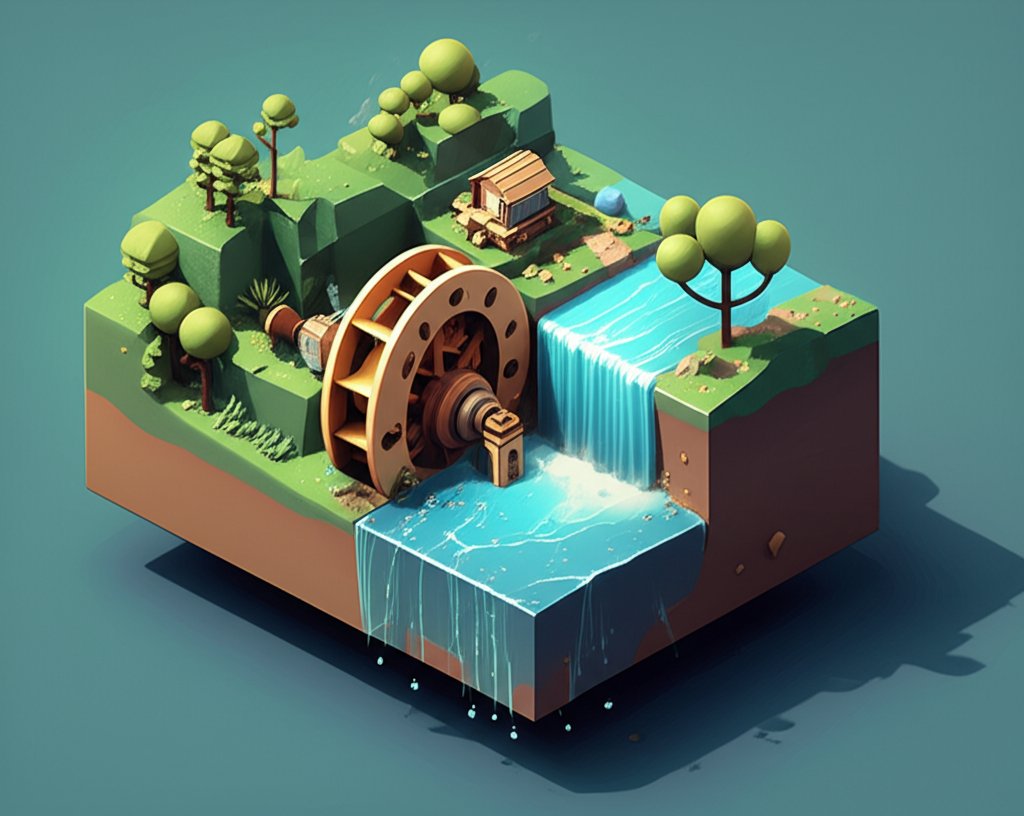
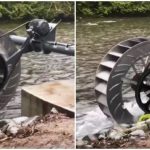
An impulse turbine works like a water wheel. It uses the velocity of the water hitting buckets or blades to spin the generator. It’s best suited for sites with a significant vertical drop.
How it Works: A nozzle creates a high-speed jet of water that strikes the turbine’s “buckets.” The turbine operates in the air, not submerged in water.
Ideal Conditions: High head (over 20 feet) and low-to-moderate flow. Perfect for hillside streams.
Example Models: The Scott Hydro Turbine (1500W) is a classic example that thrives on a 20-foot head or more. The PowerSprout TRG also offers high-head models.
Reaction Turbines: For Low Head, Higher Flow
A reaction turbine uses the pressure and mass of moving water, not just its velocity. It operates fully submerged and is designed to handle large volumes of slower-moving water.
How it Works: The turbine looks more like a boat propeller inside a tube. The pressure difference created by the flowing water across its blades causes it to spin.
Ideal Conditions: Low head (as little as 2-10 feet) but high flow. Perfect for larger, slow-moving rivers.
Example Models: Many custom-built or larger micro-hydro systems use a propeller or Kaplan-style reaction turbine. The popular portable WaterLily Turbine is technically a reaction turbine, designed to capture energy from river currents.
| Feature | Impulse Turbine (e.g., Pelton, Turgo) | Reaction Turbine (e.g., Propeller, Kaplan) |
| :— | :— | :— |
| Best For | High Head / Low Flow | Low Head / High Flow |
| Mechanism | Water jet strikes buckets in open air | Submerged blades use water pressure & flow |
| Typical Site | Steep creeks, waterfalls | Rivers, large streams with gentle slopes |
| Efficiency | Highly efficient in the right conditions | Can be very efficient with high water volume |
| Complexity | Generally simpler mechanics | Can be more complex to install and maintain | The Takeaway: Don’t buy a powerful impulse turbine if you only have a flat, slow river. And don’t install a reaction turbine at the base of a waterfall. Let your site’s geography make the decision for you.
Sizing Your System: A Reality Check on Power Needs
Now that you know what’s possible, let’s figure out what’s necessary. A common mistake is overestimating power needs, which leads to oversized, overpriced systems. A generator with water provides consistent, 24/7 power (unlike solar), so you may need a smaller system than you think.
Hydro systems are categorized by their output:
Pico Hydro: Up to 5 kW. Ideal for charging devices, running lights, or powering a small cabin.
Micro Hydro: 5 kW to 100 kW. Capable of powering a full-size home or a small farm.
Step 1: Conduct an Energy Audit
List every appliance you plan to run. Note its wattage and how many hours per day it will be used.
The Bare Essentials (Small Cabin/Campsite):
LED Lights (4 x 10W for 4 hrs) = 160 Watt-hours
Phone/Laptop Charging (25W for 5 hrs) = 125 Watt-hours
Small Water Pump (50W for 1 hr) = 50 Watt-hours
Total Daily Need: ~335 Watt-hours
The Comfortable Homestead (Efficient Home):
Energy Star Refrigerator (150W running 8 hrs/day) = 1200 Watt-hours
LED Lights, Electronics, Pump = 500 Watt-hours
Well Pump (750W for 1 hr) = 750 Watt-hours
Total Daily Need: ~2450 Watt-hours (or 2.45 kWh)
An average American home without electric heat uses around 1000W of consistent power. A generator producing 1 kW (1000W) continuously generates 24 kWh per day, which is more than enough for most efficient off-grid homes.
Step 2: Don’t Forget the Rest of the System
The turbine itself is just the engine. You need a complete powertrain to make the electricity usable and available when you need it.
Batteries: Since your generator runs 24/7, you might only need a small battery bank to handle peak loads (like a well pump starting up) that exceed the turbine’s instantaneous output. For smaller pico systems charging devices, a portable power station works perfectly. For whole-home systems, you’ll need a bank of deep-cycle lead-acid or lithium batteries.
Inverter: The turbine generates DC power. An inverter converts this to AC power to run standard household appliances. The inverter must be sized to handle the maximum wattage you’ll ever draw at one time.
Charge Controller: This device sits between the turbine and the batteries, preventing them from overcharging, which is crucial for extending battery life.
According to the National Renewable Energy Laboratory (NREL), the total installed cost for a micro-hydropower system can range from $1,000 to $5,000 per installed kilowatt, factoring in all these components.
Which Generator Profile Fits You?
Let’s ground this in reality. Here are a few user profiles and the type of generator with water that would be a perfect fit.
The Backpacker & River Kayaker
Need: Charge a phone, GPS, and camera on the go. Portability is everything.
Water Source: Any moving river or stream.
Solution: A pico-hydro turbine like the WaterLily Turbine (up to 15W). It’s lightweight, designed to be dropped into a current, and outputs power via USB and 12V connections. It’s the ultimate set-it-and-forget-it charger for multi-day trips.
The Small Off-Grid Cabin Owner
Need: Power for LED lights, a small water pump, and electronics. Reliability and low noise are key.
Water Source: A creek with a decent drop (15-20 feet) but modest flow.
Solution: A small impulse turbine like the Energy Systems and Design Watter Buddy (200W) or the Suneco 500W Hydro Turbine. These require a bit of plumbing (usually a PVC pipe to build head pressure) but can easily meet the 300-500 Watt-hour daily needs of a simple cabin. A model like the Beduan Micro Generator, which operates below 55dB, is perfect for maintaining peace and quiet.
The Full-Time Homesteader
Need: Power an efficient home, including a refrigerator, well pump, and tools. The system must be robust and low-maintenance.
Water Source: A year-round stream with significant head (20+ feet) and consistent flow.
Solution: A micro-hydro impulse turbine like the Scott Hydro Turbine (1500W) or a PowerSprout TRG. These are serious machines built for longevity. A 1.5 kW system running continuously produces 36 kWh per day—more than enough for a modern, energy-conscious household.
Quick Answers to Common Questions
Q: How much does a generator with water really cost?
A: It varies wildly. A portable pico turbine for charging devices can be $150-$300. A small cabin system might cost $1,000-$3,000 for all components. A full home system can range from $5,000 to over $20,000, depending on the power output and site complexity. Q: Are these systems noisy?
A: Not at all like a gas generator. The main sound is the rush of water. Well-designed turbines are surprisingly quiet. The context research notes some models like the Beduan generator operate under 55dB, which is quieter than a normal conversation. Q: Do I need a permit to install a micro-hydro system?
A: Almost certainly, yes. Water rights and environmental regulations are complex and vary by state and even county. Diverting water from a stream can impact local ecosystems. Always consult your local authorities before purchasing or installing any permanent system. Q: What about maintenance?
A: One of the biggest advantages of hydropower is its low maintenance. The primary task is keeping the water intake screen clear of leaves and debris. A well-built turbine can run for years with only occasional bearing checks.
Your Next Steps: A Simple Decision Framework
Feeling overwhelmed? Don’t be. Follow this simple path to find the right generator with water.
Measure Your Site First: Before you do anything else, get solid numbers for your Head and Flow. This single step will eliminate 90% of the wrong choices.
Define Your Power Budget: Complete a realistic energy audit. How many Watt-hours do you truly need per day?
Choose Your Turbine Type:
If you have High Head (>20 ft), you are in the market for an Impulse Turbine.
If you have Low Head (<10 ft) and High Flow, you need a Reaction Turbine.
Select a Model & System: With the above data, you can now confidently shop for a turbine that matches your site’s potential and your power needs. Remember to budget for the batteries, inverter, and wiring that complete the system.
A water-powered generator isn’t an off-the-shelf appliance; it’s a permanent and powerful upgrade to your off-grid life. By starting with your land and your needs, you can unlock one of the most reliable and satisfying sources of clean energy available.
I am a writer who loves renewable energy, with a focus on sustainable living, renewable energy, and eco-friendly innovation. With a passion for environmental awareness and a desire to explore the latest trends in green technology, corporate sustainability, and climate action. Through in-depth storytelling