Harnessing the steady, quiet power of moving water feels like something from a bygone era, but a modern water mill electricity generator can be a surprisingly practical way to produce reliable, 24/7 off-grid power. Unlike solar or wind that depend on the weather, a flowing stream offers a constant source of energy. With the right setup, even a modest creek can be transformed into a personal power plant, running lights, charging devices, and reducing your reliance on the grid.
This isn’t about massive concrete dams; it’s about small-scale, sustainable energy that you can build and maintain yourself. This guide breaks down exactly what you need to know to assess your property, choose the right design, and understand the components required to turn flowing water into free electricity for your home.
Assess Your Site’s Potential: Learn how to measure the two most critical factors—”head” (vertical drop) and water “flow” (gallons per minute)—to determine if your water source is viable.
Choose the Right Wheel Design: Discover the four main types of water wheels (Overshot, Breastshot, Undershot, Pitchback) and which one is best suited for your specific stream conditions.
Understand the Core Components: Go beyond the wheel itself to see how the drivetrain, generator, and electrical system work together to create usable household power.
Compare to Modern Turbines: Get a clear, honest look at how a traditional water mill stacks up against a modern micro-hydro turbine in terms of cost, efficiency, and complexity.
Get Actionable Build Insights: Find practical steps and safety considerations for constructing a durable and effective water mill generator system.
First, Can Your Property Actually Power a Water Mill?
Before you start sketching designs or buying parts, you need to answer one question: does your water source have enough energy to be useful? The power potential of your stream or creek comes down to two simple measurements.
The Two Numbers That Matter: Head and Flow
All micro-hydro power, including that from a water mill, is a product of vertical drop and water volume.
Head: This is the vertical distance the water falls. Think of it as the “pressure” behind the water. A higher drop equals more potential energy. You need a minimum head of just 3 feet to make a system worthwhile.
Flow: This is the volume of water moving through your system, typically measured in gallons per minute (GPM). You need a minimum flow of about 20 GPM. A Quick Field Test:
To measure flow: Use a 5-gallon bucket and a stopwatch. Build a temporary dam to channel all the water through a pipe or trough. Time how long it takes to fill the 5-gallon bucket. If it takes 30 seconds, your flow is (5 gallons / 30 seconds) x 60 seconds/minute = 10 GPM.
To measure head: Use a string level or a laser level to find the vertical distance between where the water will enter your system (the intake) and where it will hit the wheel.
The more head and flow you have, the more power you can generate. A site with a 3-foot head and 20 GPM is on the low end but can still power a few lights. A site with a 10-foot head and 100 GPM can run a significant portion of a small home.
Calculating Your Power Potential
The basic formula for calculating potential energy in kilowatts (KW) gives you a realistic estimate of what to expect. KW = 0.004 x Q x V x H x C
Let’s break that down:
Q = Weight of water (volume per second x bucket capacity)
V = Flow velocity (meters per second)
H = Head (in meters)
C = Efficiency Constant (a water mill is typically around 50%, or 0.5)
While this formula is precise, the key takeaway is simple: doubling your head or your flow roughly doubles your potential power.
Choosing Your Water Wheel: Matching Design to Your Stream
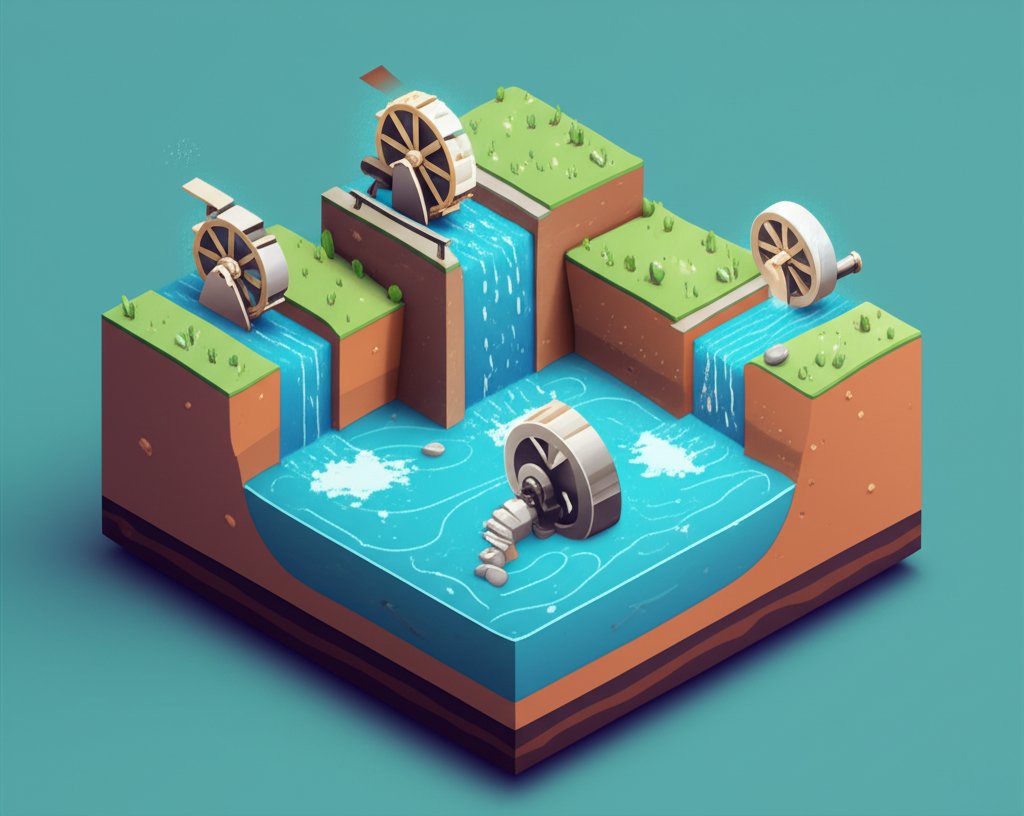
The classic water wheel isn’t a one-size-fits-all solution. There are four primary designs, each tailored to different conditions of head and flow. Choosing the right one is critical for maximizing the efficiency of your water mill electricity generator.
The efficiency of these designs is a measure of how much of the water’s potential energy is converted into rotational energy. Understanding these designs is the first step in a broader project. For a complete overview of how these components fit into a full system, see our guide to Generate free electricity at home.
Wheel Type
How It Works
Best For
Typical Efficiency
Overshot
Water is channeled into buckets at the top of the wheel. Gravity does most of the work as the heavy buckets pull the wheel down.
High Head (significant drop), Lower Flow.
60-70%
Breastshot
Water strikes the wheel’s blades around its midpoint (the “breast”). It combines the force of the current with the weight of the water.
Moderate Head, Moderate Flow.
50-60%
Undershot
The wheel sits directly in the current, which pushes against paddles at the bottom. It relies purely on the water’s kinetic energy.
Low Head (minimal drop), High Flow (like a steady river).
20-30%
Pitchback
A hybrid where water enters just behind the top of the wheel, turning it in the opposite direction of the flume. Combines gravity and reaction force.
Moderate to High Head.
60-70%
For most homestead-scale projects with a noticeable drop, the Overshot or Breastshot designs offer the best balance of efficiency and construction simplicity. The Undershot is the easiest to build but is also the least efficient, making it suitable only where you have strong, consistent flow but almost no vertical drop.
The Core Components of Your Generator System
The water wheel is the engine, but it’s only one part of the system. To get usable electricity, you need a few more key components working in concert.
1. The Water Wheel
This is the heart of your system. It must be built from durable, weather-resistant materials like pressure-treated wood, steel, or high-density plastic. Precision matters—a well-balanced wheel with smooth-turning bearings will capture far more energy than a wobbly, high-friction one.
2. The Drivetrain: Gearing Up for Power
Water wheels turn slowly, often just 5-20 revolutions per minute (RPM). Generators need to spin much faster—hundreds or even thousands of RPM—to produce electricity efficiently. The drivetrain connects the two and increases the speed using:
Gears, Pulleys, or Sprockets: A small gear on the generator shaft connected to a large gear on the wheel shaft will multiply the rotation speed. A common DIY approach uses bicycle sprockets and a chain. Case Snippet: A homesteader in the Pacific Northwest used an old truck alternator connected via a bicycle chain to a 4-foot breastshot wheel. The 10-to-1 gear ratio was enough to get the alternator spinning fast enough to charge a 12-volt battery bank, powering lights and a small refrigerator.
3. The Generator
This is what converts mechanical motion into electrical current. You have two main options:
Alternator: A car or truck alternator is a common choice for DIY projects. They are designed to charge 12V batteries but often require high RPMs to work effectively.
Permanent Magnet DC Motor: Many DC motors can be run in reverse to act as generators. They often produce power at lower RPMs than alternators, making them a better match for water wheels. A pre-built dynamo designed for micro-hydro is the most efficient but also the most expensive option.
4. The Balance of System
This includes all the electrical components that condition and store the power:
Charge Controller: Prevents the batteries from overcharging.
Battery Bank: Stores the electricity for use when needed. Deep-cycle batteries are essential.
Inverter: Converts the low-voltage DC power from the batteries into 120V AC power that your household appliances use.
Water Mill vs. Modern Micro-Hydro: What’s the Real Difference?
A traditional water mill generator is not the only way to harness a stream’s power. Modern micro-hydro systems use compact, high-speed turbines. Here’s how they compare.
Feature
Water Mill Generator
Modern Micro-Hydro Turbine
Efficiency
Lower (50-70%)
Very High (up to 90%+)
Initial Cost
Lower, especially if DIY.
Higher, requires precision-engineered parts.
Complexity
Simple, visible mechanics. Easy to repair.
Complex internal components. Often requires a specialist.
Maintenance
More frequent (clearing debris, lubricating bearings).
Less frequent but more technical.
RPM
Very low (requires gearing up).
Very high (can often connect directly to a generator).
Visual Impact
Aesthetically pleasing, classic look.
Small, often hidden in a small powerhouse.
The Bottom Line: A water mill is a fantastic choice if your priorities are lower upfront cost, simplicity of repair, and you enjoy the aesthetic of visible, working mechanics. A modern turbine is better if your sole focus is maximizing electrical output from your available water resource.
Quick Answers to Common Questions
Q: How much electricity can a small water mill actually generate?
A: A well-built, medium-sized system can reliably produce a few hundred watts continuously. This is enough to power a small, energy-efficient home’s essentials: several LED light bulbs, a TV, a radio, and device chargers, all running simultaneously. It provides consistent baseline power, 24/7. Q: Do I need a dam for a water mill generator?
A: No. Nearly all small-scale systems are “run-of-the-river,” meaning they only divert a portion of the stream’s flow to power the wheel. The water is then returned to the stream immediately downstream. This approach has a much smaller environmental footprint than a dam. Q: Is building a water mill generator legal?
A: This is a critical question. Water rights and local building regulations vary dramatically. You may need permits for diverting water, even for a small run-of-the-river system. Always check with your local zoning, environmental, and water resource authorities before starting any construction. Q: What is the single biggest mistake people make?
A: Underestimating the importance of the drivetrain. Many first-time builders get a wheel spinning beautifully but fail to gear it up properly to match the generator’s speed requirements. The result is little to no power output. The second biggest mistake is not building a robust intake screen, which leads to constant clogging from leaves and debris.
Your Next Steps: From Idea to Kilowatts
Building a water mill electricity generator is a rewarding project that blends traditional engineering with modern energy needs. It’s a commitment, but the payoff is a resilient, independent power source that runs day and night.
Ready to move forward? Here’s your action plan:
Confirm Your Site’s Potential: Get out there with a bucket and a level. Measure your head and flow accurately. If you don’t have the minimums (3 ft head, 20 GPM), this project may not be viable.
Choose Your Design: Based on your site’s numbers, select the most efficient wheel type—likely an overshot for a good drop or a breastshot for a more moderate site.
Research Local Regulations: Make the calls. Talk to your county’s planning department and state environmental agency about water rights and permitting. This step is non-negotiable.
Start Sourcing Components: Begin pricing out the key parts. A good permanent magnet DC motor or a high-quality alternator is an excellent place to start, as it will dictate the gearing you need for your drivetrain.
With careful planning and a bit of mechanical ingenuity, that stream in your backyard could be more than just a scenic feature—it could be the key to your energy independence.
I am a writer who loves renewable energy, with a focus on sustainable living, renewable energy, and eco-friendly innovation. With a passion for environmental awareness and a desire to explore the latest trends in green technology, corporate sustainability, and climate action. Through in-depth storytelling