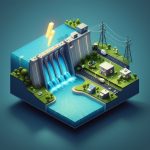
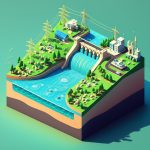
When a summer heatwave hits the West Coast, millions of air conditioners hum to life, placing an immense strain on the electrical grid. Much of the immediate, on-demand power that keeps the lights on without a flicker comes from the immense turbines of the Grand Coulee Power Plant. This single facility on the Columbia River isn’t just a dam; it’s a massive, flexible energy-producing system that has anchored the Pacific Northwest’s power supply and agricultural economy for nearly a century.
Understanding how this behemoth operates reveals why it remains the undisputed king of American hydropower. It’s a story of four distinct power-generating facilities working in concert, each with a specific role, from providing steady, all-day baseload power to acting like a colossal rechargeable battery for the entire region.
This deep dive will unpack the operational heart of the Grand Coulee Dam. Here’s what you’ll learn:
The Four-in-One Design: Discover the distinct roles of the Left, Right, and Third Powerplants, plus the unique Pump-Generating Plant.
Capacity vs. Reality: Learn the difference between the plant’s 6,809 MW “nameplate capacity” and its real-world output, which tops 21 billion kWh annually.
More Than Megawatts: See how the plant’s design is inseparable from its other primary mission: irrigating over 670,000 acres of Washington farmland.
A Giant Water Battery: Understand how the pump-storage system provides critical grid stability, a function more vital than ever in the age of intermittent renewables.
The Engineering Legacy: Grasp the decisions behind its construction and expansion that shaped the energy landscape of the American West.
The Anatomy of a Hydroelectric Behemoth
To truly appreciate the Grand Coulee Power Plant, you have to stop thinking of it as one single entity. It’s a complex of four interconnected powerhouses, built in different eras for different purposes, that together form the largest power-producing facility in the United States.
The Original Workhorses: Left and Right Powerhouses
Built as part of the initial project between 1933 and 1942, the Left and Right Powerhouses are the dam’s original heart. They were monumental achievements of the Great Depression, providing both jobs and the promise of cheap, abundant power. During World War II, their output was a critical strategic asset, powering aluminum smelters for aircraft production and fueling the plutonium-producing reactors at the Hanford Site for the Manhattan Project.
Left Powerhouse: Contains nine main generators plus three smaller station service units that power the dam’s own operations.
Right Powerhouse: Mirrors the left side with another nine main generators.
Together, these two powerhouses provide a combined capacity of 2,280 MW. They are the baseload workhorses, designed for consistent, round-the-clock power generation that forms the foundation of the regional grid’s energy supply.
The Big Hitter: The Third Powerplant
By the 1960s, the Pacific Northwest’s demand for electricity was booming. To meet this need, and to fulfill obligations under the Columbia River Treaty with Canada, the U.S. Bureau of Reclamation embarked on a massive expansion. The result was the Third Powerplant, constructed between 1967 and 1974.
This isn’t just an addition; it’s a game-changer. Housing six massive generators, including three 600 MW units and three 805 MW units, the Third Powerplant alone boasts a capacity of 4,215 MW—nearly double that of the original two powerhouses combined. These giant units are designed to act as “peakers,” meaning they can be brought online quickly to meet periods of high demand, providing essential flexibility to the grid.
The Balancing Act: The John W. Keys III Pump-Generating Plant
The most innovative component of the Grand Coulee Power Plant is its pump-storage facility. Think of it as a giant, water-based rechargeable battery. The plant features six pump-generators, which can either push water uphill or generate power from water flowing downhill.
Here’s how it works:
Charging: During periods of low electricity demand (like the middle of the night), when power is cheap, the units operate as pumps. They move massive amounts of water from Lake Franklin Delano Roosevelt up a 280-foot incline into a storage reservoir, Banks Lake.
Discharging: When demand for electricity spikes (like a hot afternoon), the flow is reversed. Water is released from Banks Lake back down through the same units, which now function as generators, producing up to 314 MW of valuable peaking power.
This system provides critical grid-stabilizing services, helping to smooth out the fluctuations from other power sources. But its primary function has always been irrigation—Banks Lake is the linchpin of the Columbia Basin Project.
From River Flow to Regional Grid
The raw power of the Grand Coulee Power Plant comes from a simple principle: converting the potential energy of water stored in the 151-mile-long Lake FDR into electrical energy. The dam’s 550-foot height creates immense water pressure, or “hydraulic head,” which is channeled through massive pipes called penstocks to spin the 33 turbines. Each spinning turbine turns a generator, producing electricity that is then stepped up in voltage and sent out across the transmission network.
With an annual output exceeding 21 billion kilowatt-hours, a common question is exactly Who gets Grand Coulee power?, as its reach extends far beyond the immediate vicinity of the Columbia River. This output isn’t static; it’s managed minute-by-minute by operators who balance river flows, irrigation needs, and the ever-changing demands of the grid.
A Practical Playbook: Understanding the Plant’s Grid Impact
The genius of the Grand Coulee Power Plant lies in its operational flexibility. The different powerhouses are not used identically; they are dispatched to meet specific grid needs, primarily categorized as baseload, peaking, and ancillary services.
The table below breaks down the distinct roles of each component:
Powerhouse
Commissioned
No. of Units
Total Capacity (MW)
Primary Role
Left Powerhouse
1941-1950
9 Main, 3 Station
1,225
Baseload Power, Station Service
Right Powerhouse
1941-1950
9 Main
1,055
Baseload Power
Third Powerplant
1974-1975
6 Main
4,215
Peaking Power, Grid Stability
Pump-Generating Plant
1973-1984
6 Pump-Generators
314 (as generators)
Grid Balancing, Irrigation Pumping
What “Peaking Power” vs. “Baseload Power” Really Means
Understanding these two concepts is key to grasping Grand Coulee’s importance.
Baseload Power (Left & Right Powerhouses): This is the steady, predictable, 24/7 power that covers the minimum level of demand on the grid. The original powerhouses are ideal for this, running consistently and efficiently to form the bedrock of the region’s electricity supply.
Peaking Power (Third Powerplant): This is electricity that can be generated on short notice to meet spikes in demand. When people come home from work and turn on their lights, appliances, and TVs, the Third Powerplant’s massive generators can quickly ramp up to meet that surge, preventing brownouts and keeping the grid stable.
Ancillary Services (Pump-Generating Plant): This refers to functions that support the reliable operation of the grid. The pump-storage facility’s ability to absorb excess power (by pumping) and inject power quickly (by generating) helps regulate grid frequency and voltage, a service that is increasingly vital to accommodate intermittent renewable sources like wind and solar.
Common Questions About the Grand Coulee Power Plant
Even with its long history, several misconceptions and questions persist about this engineering marvel. Q: Is Grand Coulee the biggest dam in the world?
No. While it is the largest power producer in the United States, dams like the Three Gorges Dam in China are physically larger and have a greater generating capacity. However, Grand Coulee remains one of the largest concrete structures ever built. Q: Why doesn’t Grand Coulee have fish ladders?
The “high dam” design, chosen in 1934 to maximize power and irrigation potential, created a barrier too tall for the fish ladder technology of the era. At 550 feet, it was deemed impossible for anadromous fish like salmon and steelhead to pass. The decision permanently blocked over 1,100 miles of their historic upstream spawning habitat, a significant environmental and cultural trade-off for the dam’s economic benefits. Q: How much electricity does it actually produce in a year?
Its annual generation averages over 21 billion kilowatt-hours (kWh). To put that into perspective, the U.S. Energy Information Administration states the average U.S. home uses about 10,600 kWh per year. Grand Coulee’s output is enough to power nearly 2 million of those homes annually. Q: Can the plant operate during a drought?
Yes, but its output can be significantly curtailed. The enormous Franklin Delano Roosevelt Lake provides a buffer, but a prolonged drought lowers the reservoir’s level. This reduces the “hydraulic head”—the vertical distance the water falls—which directly impacts the force spinning the turbines and, consequently, the amount of electricity generated.
The Enduring Legacy and Future of an American Icon
For nearly a century, the Grand Coulee Power Plant has been far more than a structure of concrete and steel. It is the engine that powered the industrialization of the Pacific Northwest, the heart of an agricultural oasis, and a critical backstop for the Western electrical grid.
Today, its role is evolving once again. As the grid incorporates more variable energy sources like wind and solar, the stability, flexibility, and massive energy storage capability of Grand Coulee become even more indispensable. It stands not just as a monument to the ambition of a past generation, but as a dynamic and essential asset for a clean energy future. The enduring giant on the Columbia River is poised to anchor the region’s power for decades to come.
I am a writer who loves renewable energy, with a focus on sustainable living, renewable energy, and eco-friendly innovation. With a passion for environmental awareness and a desire to explore the latest trends in green technology, corporate sustainability, and climate action. Through in-depth storytelling