Of course. Here is the detailed cluster article on cool facts about hydroelectricity, crafted to your specifications.
Cool Facts about Hydroelectricity and Water’s Green Rechargeable Battery
When most people picture renewable energy, they think of solar panels or wind turbines. But some of the most genuinely cool facts about hydroelectricity reveal it as the original, and still reigning, champion of clean power. It’s a technology that’s both ancient and cutting-edge, transforming the simple force of falling water into a reliable cornerstone of our energy grid.
This isn’t just about big dams. It’s about 90% efficiency rates that dwarf other power sources, massive water batteries that store energy for entire cities, and a history stretching back two millennia. Let’s dive into what makes this technology so powerful.
At a Glance: What You’ll Discover
- Unbeatable Efficiency: Learn why modern hydro turbines can convert 90% of water’s energy into electricity, far surpassing fossil fuels.
- The Original Rechargeable Battery: Understand how pumped-storage hydropower works to store massive amounts of energy and balance the grid.
- Global Scale and Surprising History: See the numbers behind hydropower’s dominance as the world’s largest renewable source and trace its roots back to ancient civilizations.
- Innovations for a Greener Future: Explore how modern advancements like fish-friendly turbines and floating solar panels are making hydro even more sustainable.
Beyond Efficiency: Why Hydropower Is a Different Class of Energy
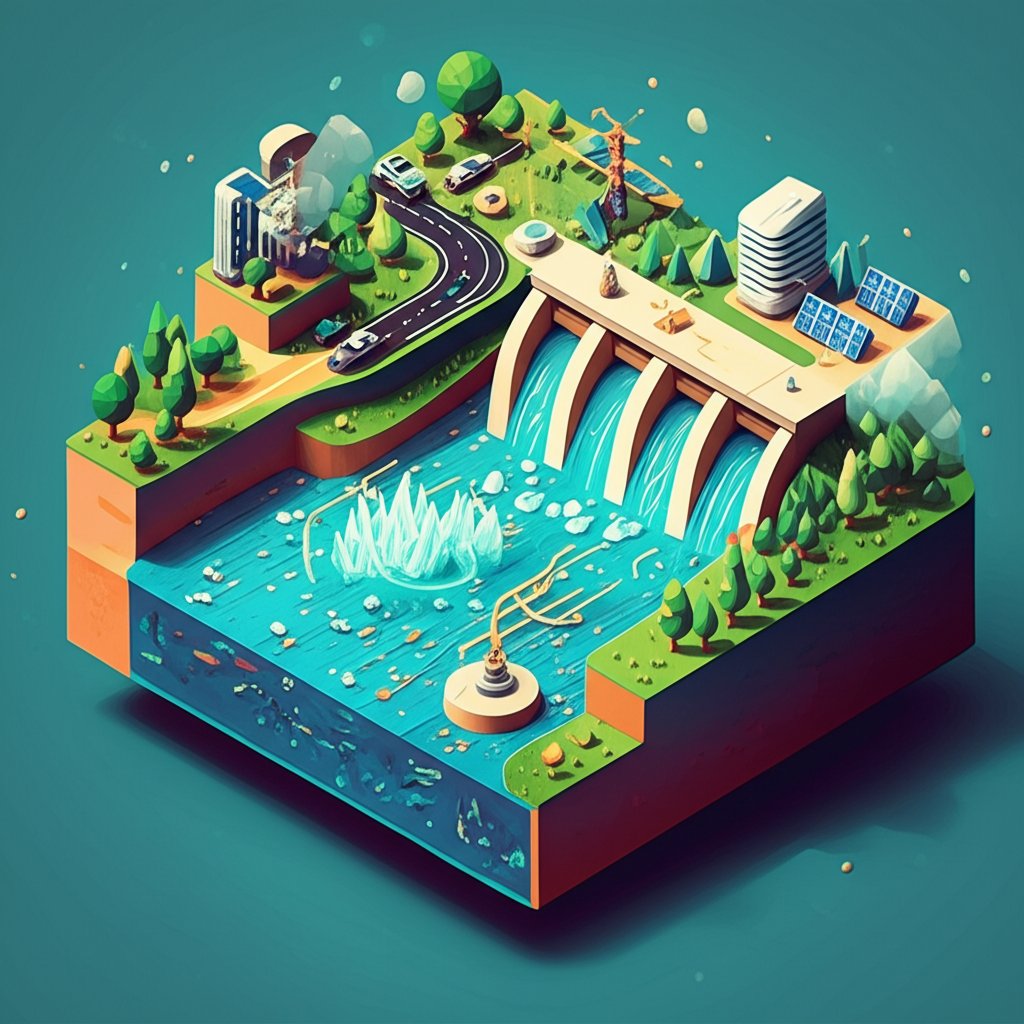
The core principle of hydropower is simple: water held at a height has potential energy. When it flows downward, that potential energy converts to kinetic energy, which spins a turbine connected to a generator. But the elegance of this process hides some astounding performance metrics.
A typical thermal power plant, like one burning coal or natural gas, struggles to reach 50% efficiency. Much of the energy is lost as waste heat. In contrast, a modern hydroelectric turbine, like the Francis turbine design first developed in 1849, can achieve up to 90% efficiency. It converts nearly all the water’s kinetic energy into clean electricity. This is a fundamental advantage that makes every drop of water count.
There isn’t just one way to harness this power. The main types of hydropower show remarkable versatility:
- Impoundment (Storage) Hydropower: This is the classic dam and reservoir system. The dam creates a large body of water, controlling the flow to generate a steady, predictable supply of electricity.
- Run-of-River Hydropower: These facilities divert a portion of a river’s flow through a channel or pipe to spin a turbine. They cause less disruption to a river’s natural course and are ideal for areas with consistent flow.
- Pumped-Storage Hydropower: This is where things get really clever. This system is less a generator and more a massive, grid-scale battery.
These different approaches allow hydropower to be adapted to diverse geographies and energy needs. For a complete overview of how these systems fit into the global energy picture, you can Explore hydropower’s enduring potential.
The Original Green Battery: Pumped Storage Explained
Imagine needing to store enough energy to power a city during peak demand. You can’t put wind or solar energy in a box for later. But with pumped-storage hydropower (PSH), you can—using water and gravity.
PSH facilities have two reservoirs at different elevations. Here’s the cycle:
- Charging (Low Demand): At night, when electricity demand is low and prices are cheap (often due to excess wind or solar power), the system uses this surplus energy to pump water from the lower reservoir to the upper one. The water in the upper reservoir now holds a massive amount of stored potential energy.
- Discharging (High Demand): During the day, when demand spikes, the facility releases the water from the upper reservoir. It flows back down through the turbines, generating electricity quickly to meet the peak need.
Think of it like carrying a bucket of water up a hill when you have extra energy, then pouring it out to spin a water wheel when you need that energy back. As of 2024, there are 189 gigawatts (GW) of pumped storage capacity globally, acting as giant, rechargeable water batteries that stabilize power grids and enable the growth of intermittent renewables like solar and wind.
A Global Powerhouse: Hydropower by the Numbers
The scale of hydropower is often underestimated. It is, by a significant margin, the largest single source of renewable electricity on the planet, accounting for over 50% of the world’s total renewable generation.
The statistics tell a powerful story:
- Installed Capacity: The world has 1,443 GW of hydropower capacity, with China, Brazil, the US, Canada, and Russia leading the charge.
- Massive Projects: The Three Gorges Dam in China is the world’s largest power station of any kind, with a staggering 22.5 GW capacity. That’s equivalent to about 22 large nuclear reactors. Brazil and Paraguay’s Itaipu Dam, at 14 GW, is another giant.
- Cost-Effectiveness: Hydropower is one of the cheapest sources of electricity. The average global cost in 2022 was just US$0.061 per kilowatt-hour.
- Climate Impact: By providing clean, reliable power, hydropower helps avoid over 4 billion tons of CO2 emissions annually compared to burning coal.
| Country | Installed Hydropower Capacity (GW) |
| :— | :— |
| China | 421 |
| Brazil | 110 |
| United States | 102 |
| Canada | 83 |
| Russia | 56 |
Data reflects recent estimates and highlights the top global producers.
From Ancient Gristmills to Fish-Friendly Turbines

While we think of hydropower as a modern technology, its roots are ancient. As far back as the Han Dynasty in 202 BC, humans used water wheels to grind grain. The Romans built complex systems for irrigation and milling.
But the industry is far from static. Modern innovation is focused on improving performance and reducing environmental impact.
Modern Hydropower Innovations
- Advanced Turbine Design: New “fish-friendly” turbines are engineered to reduce pressure changes and blade strikes, allowing a higher percentage of fish to pass through dams safely.
- Floating Solar (Floatovoltaics): Hydropower reservoirs are now being used as platforms for floating solar panels. This hybrid approach has multiple benefits: the panels produce extra power, their shade reduces water evaporation from the reservoir, and the cool water helps the panels operate more efficiently.
- Micro-Hydropower Systems: For remote communities, small-scale systems (10-100 KW) can be installed on small rivers or streams without the need for a large dam. These provide reliable, localized power and are a game-changer for rural development.
- Smarter Operations: Using AI and advanced weather forecasting, operators can manage water release more precisely, maximizing power generation while meeting environmental and flood control needs.
These advancements show that hydropower is not a relic but a dynamic technology continuously adapting to the demands of a cleaner energy future.
Quick Answers to Common Hydropower Questions
Let’s tackle some frequent questions and misconceptions about hydroelectric power.
Q: Isn’t hydropower bad for fish and river ecosystems?
A: This is a significant concern and a major focus of the modern hydro industry. Early dam construction did disrupt fish migration and alter ecosystems. However, new projects and retrofits on older dams include mitigation measures like fish ladders and fish-friendly turbines. These structures create bypass routes for migrating species like salmon. While impacts remain, the industry is actively working to minimize them.
Q: Do hydropower dams produce greenhouse gases?
A: The operational process of generating electricity with hydropower is emission-free. However, some emissions, primarily methane, can be released from the decomposition of organic matter in newly flooded reservoirs. The amount varies greatly depending on the climate and local geography. Despite this, life-cycle emissions from hydropower are still extremely low—on par with wind and nuclear, and far below fossil fuels.
Q: Are we running out of rivers to dam?
A: While many of the most suitable large-scale sites in developed nations have been utilized, significant untapped potential remains, particularly in Asia, Africa, and Latin America. Moreover, the biggest growth area isn’t just new dams. It includes upgrading existing facilities with more efficient turbines and, crucially, expanding pumped-storage capacity to support the broader energy transition. The International Hydropower Association estimates the world will need to add over 600 GW of new capacity by 2050 to meet climate targets.
A Legacy Powering the Future
The story of hydropower is one of enduring ingenuity. It’s a technology that has proven its worth for centuries and is now more critical than ever. From its unmatched efficiency to its unique ability to act as a grid-scale battery, hydropower provides a firm, reliable foundation upon which other renewables can be built.
To meet global net-zero targets, the world needs to accelerate the pace of sustainable hydropower development. This means not just building new plants but investing in modernizing the existing fleet and expanding pumped storage. The quiet, constant power of flowing water remains one of our greatest assets in the transition to a clean energy world.