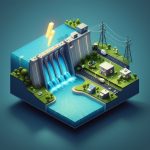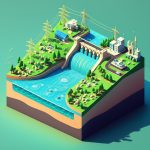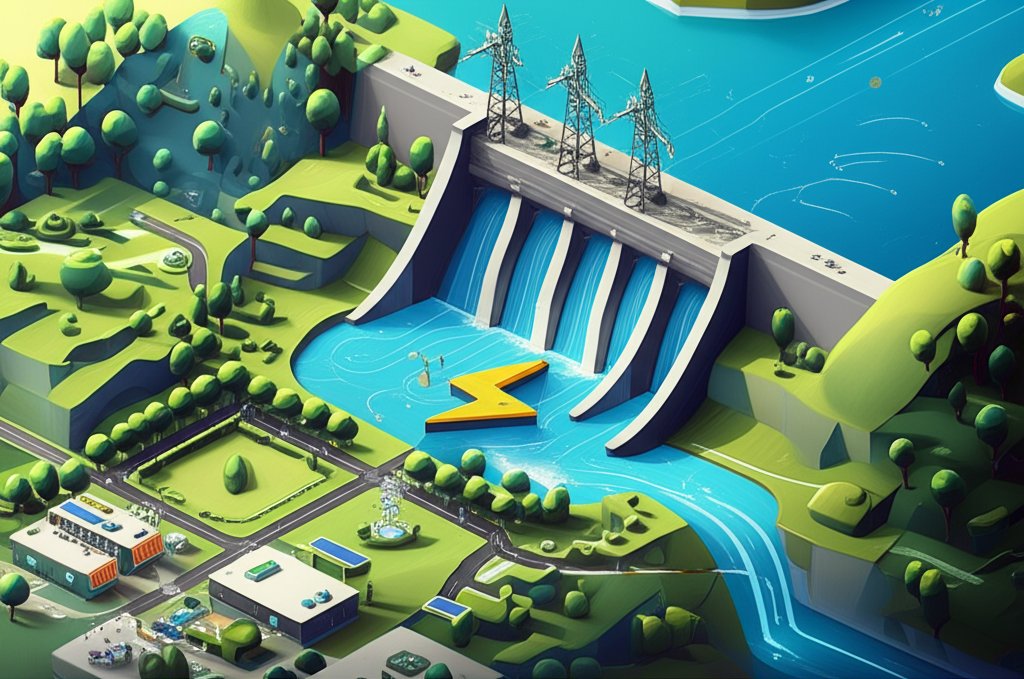
Of all the ways we generate electricity, harnessing the power of moving water feels both ancient and futuristic. While most people picture a massive dam, the world of hydroelectric energy is filled with surprising details. These fun facts about hydroelectric energy reveal a technology that’s more efficient, diverse, and historically significant than you might imagine.
From power plants that work like giant batteries to the incredible reality that only a tiny fraction of America’s dams actually produce power, the story of hydro is one of immense scale and untapped potential.
At a Glance: What You’ll Discover
- Ancient Roots, Modern Muscle: Uncover how hydropower predates modern electricity by centuries and why it’s the most efficient energy source we have.
- A World Powered by Water: Find out which countries run almost entirely on hydroelectricity and how much potential remains untapped in the U.S.
- More Than Just Mega-Dams: Explore the different types of hydro, including “water batteries” and systems that don’t require a dam at all.
- Giants of the Grid: Get a sense of the staggering scale of the world’s largest hydroelectric projects.
- The Unseen Ledger: Understand the significant environmental and social trade-offs that come with harnessing rivers.
Hydropower’s Deep History and Unmatched Efficiency
Before it was about megawatts, hydropower was about mechanical might. Its journey from simple water wheels to the backbone of national grids is a testament to its raw power and effectiveness.
A Technology Older Than the Lightbulb
The concept isn’t a 20th-century invention. Long before electricity, humans used the force of water. The modern story begins in the 1700s.
- In 1771, Cromford Mill in England used a water wheel to power its cotton-spinning machinery, a key moment in the Industrial Revolution.
- The first home in the world to be lit by hydroelectricity was Cragside House in England, back in 1878.
- In the U.S., the first hydroelectric power plant was built on the Fox River in Appleton, Wisconsin, in 1882. It powered two paper mills and a single home, proving the concept for commercial use.
These early steps set the stage for a technology that would eventually power entire cities and nations. While these facts highlight its long history, the full story of Hydropower’s power potential continues to unfold today.
The Unbeatable Efficiency of Moving Water
Here is one of the most compelling fun facts about hydroelectric energy: it’s incredibly efficient. A modern hydro turbine can convert as much as 90% of the available energy from the water into electricity.
To put that in perspective, most fossil fuel power plants have an efficiency of around 50%. It’s like getting nine out of ten cookies from the jar, while other methods drop nearly half on the floor. It takes roughly 18 gallons of water passing through a turbine to generate one kilowatt-hour (kWh) of electricity, enough to run a modern refrigerator for about 5-6 hours.
The Sheer Scale of Global Hydropower

From powering entire countries to the mind-boggling size of its largest facilities, hydropower operates on a scale that can be hard to comprehend.
Powering Entire Nations with Water
While hydropower accounts for about 16% of the world’s total electricity production, some nations have gone all-in. Norway is a prime example, generating between 96% and 99% of its electricity from its abundant water resources. Brazil, Canada, and China are also global leaders, relying heavily on hydro to power their economies.
In the United States, Washington State leads the way, producing over 70% of its electricity from hydropower. Nationwide, hydro provides enough electricity for about 28 million residential customers.
America’s Vast, Untapped Dam Potential
This may be the most surprising fact of all: the U.S. has over 80,000 dams, but only about 3% of them are equipped to generate power. Most were built for other purposes like flood control, irrigation, or recreation. This represents a massive opportunity to add electricity-generating capacity to existing infrastructure without building new dams from scratch.
A Tale of Two Titans: Comparing the World’s Largest Dams
To grasp the scale, it helps to compare the largest hydroelectric plant in the world with the largest in the United States.
| Feature | Three Gorges Dam (China) | Grand Coulee Dam (USA) |
|---|---|---|
| Max Capacity | 22,500 MW | 6,809 MW |
| River | Yangtze River | Columbia River |
| Location | Hubei Province, China | Washington State, USA |
| Fun Fact | Its reservoir is so large (over 400 miles long) that its filling was measured to slightly alter the Earth’s rotation. | It contains enough concrete to build a 4-foot-wide sidewalk around the Earth at the equator. |
| The output of the Three Gorges Dam alone is equivalent to that of more than a dozen large nuclear power plants, showcasing the immense energy locked within the world’s great rivers. |
Beyond the Dam: The Diverse Family of Hydropower
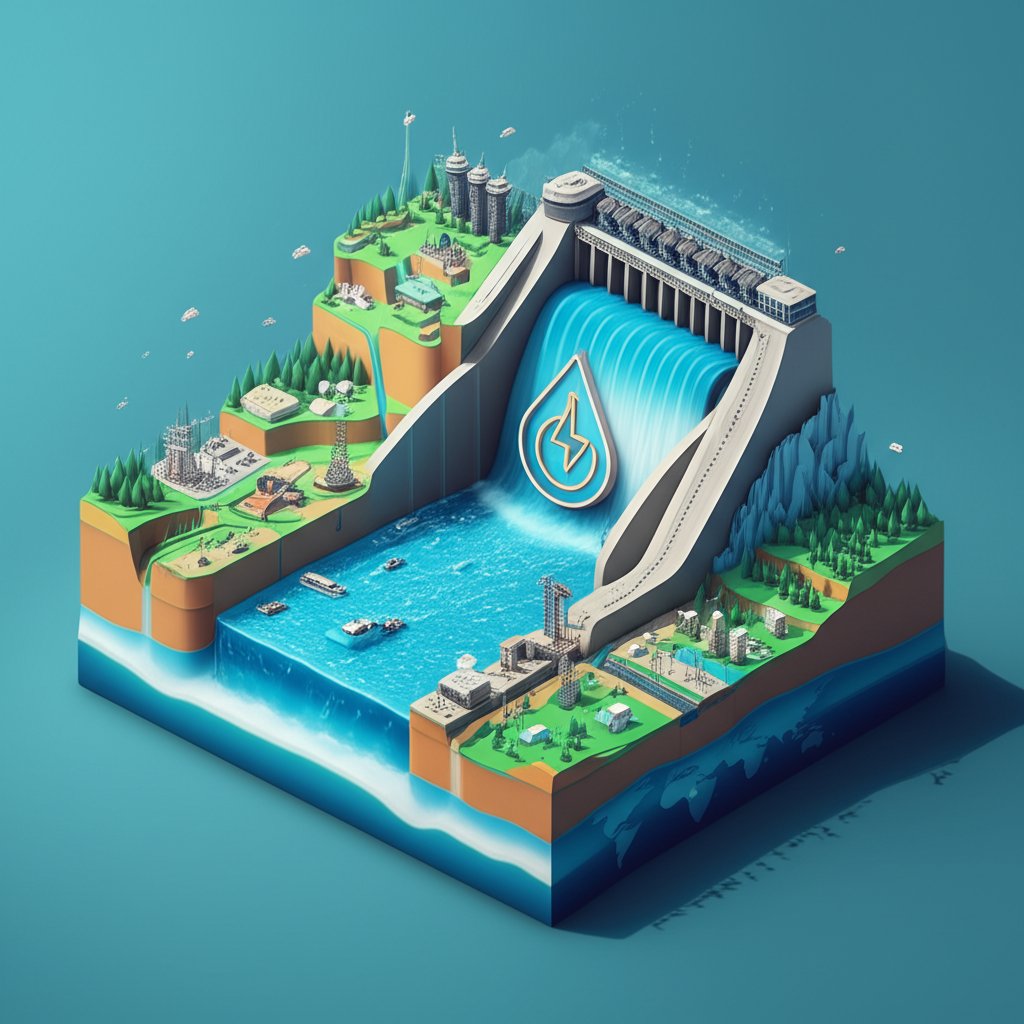
The image of a giant concrete wall holding back a massive lake is just one face of hydroelectric energy. The technology is surprisingly diverse, with different forms suited for different environments.
The Water Battery: Pumped-Storage Hydro
Pumped-storage hydropower is one of the most clever energy storage solutions available. It works like a giant, rechargeable battery for the power grid.
- Charging: When electricity is cheap and plentiful (like on a windy night or sunny day), the facility uses that power to pump water from a lower reservoir to an upper one.
- Storing: The water stays in the upper reservoir, holding that energy in potential form.
- Discharging: When demand for electricity is high, the facility releases the water from the upper reservoir, letting it flow back down through turbines to generate power.
This system is invaluable for stabilizing the grid, as it can store excess energy from intermittent sources like wind and solar and release it when needed.
Run-of-the-River: Power Without the Reservoir
Not all hydropower requires a giant dam. “Low head” or “run-of-the-river” systems divert a portion of a river’s flow through a channel or pipe to spin a turbine. Because they don’t create a large reservoir, their environmental footprint is often much smaller, though their power output can be less consistent as it depends on the river’s natural flow.
Going Small: Micro and Pico Hydro
Hydropower isn’t just for large-scale utilities.
- Micro-hydro systems generate up to 100 kW of power, enough for a small community, farm, or remote village.
- Pico-hydro is even smaller, generating less than 5 kW—often enough to power a few homes.
These small-scale solutions are life-changing in remote areas without access to a central power grid, providing reliable electricity for lighting, refrigeration, and communications.
Quick Questions on Hydropower Facts
Let’s tackle some common questions and misconceptions about hydroelectric power.
Is hydroelectric energy truly ‘clean’?
It’s complicated. Hydropower is considered clean in that its operation produces virtually no air pollution or greenhouse gas emissions. However, it’s not without environmental impact. Damming a river alters the ecosystem, can harm fish migration patterns, and affects water quality. Furthermore, the decomposition of submerged vegetation in new reservoirs can release methane, a potent greenhouse gas. So, while it’s much cleaner than fossil fuels, it’s not impact-free.
How much water does it take to power a typical home?
An average American home uses around 886 kWh of electricity per month. Based on the 18-gallons-per-kWh figure, that means about 15,948 gallons of water must pass through a turbine each month to power that one home. It sounds like a lot, but this water is immediately returned to the river downstream.
Why don’t we just put turbines on all existing dams?
Retrofitting the 97% of non-powered dams in the U.S. is a promising idea but faces challenges. Many dams weren’t structurally designed to accommodate power-generating equipment. The costs of retrofitting, combined with complex environmental permitting and the need to ensure the dam’s primary functions (like flood control) aren’t compromised, make it a case-by-case decision.
Can hydropower run out?
As a source, no. Hydropower relies on the water cycle, which is driven by the sun, making it a renewable resource. However, its output is not guaranteed. It is vulnerable to long-term droughts, which can dramatically reduce water levels in reservoirs and slash electricity production, as has been seen in the American West.
The Enduring Power of a Simple Idea
The story of hydroelectric energy is one of elegant physics scaled to epic proportions. It’s a technology that powered the first flickers of the Industrial Revolution and remains a cornerstone of the global energy supply today.
From its incredible 90% efficiency rate to the surprising fact that thousands of dams sit waiting for their power potential to be unlocked, hydropower is far from a solved chapter in our energy story. It demonstrates a powerful truth: sometimes, the most enduring solutions are the ones that work in harmony with the fundamental forces of nature. As we navigate the future, the ability to turn falling water into reliable, clean electricity will remain an indispensable tool.