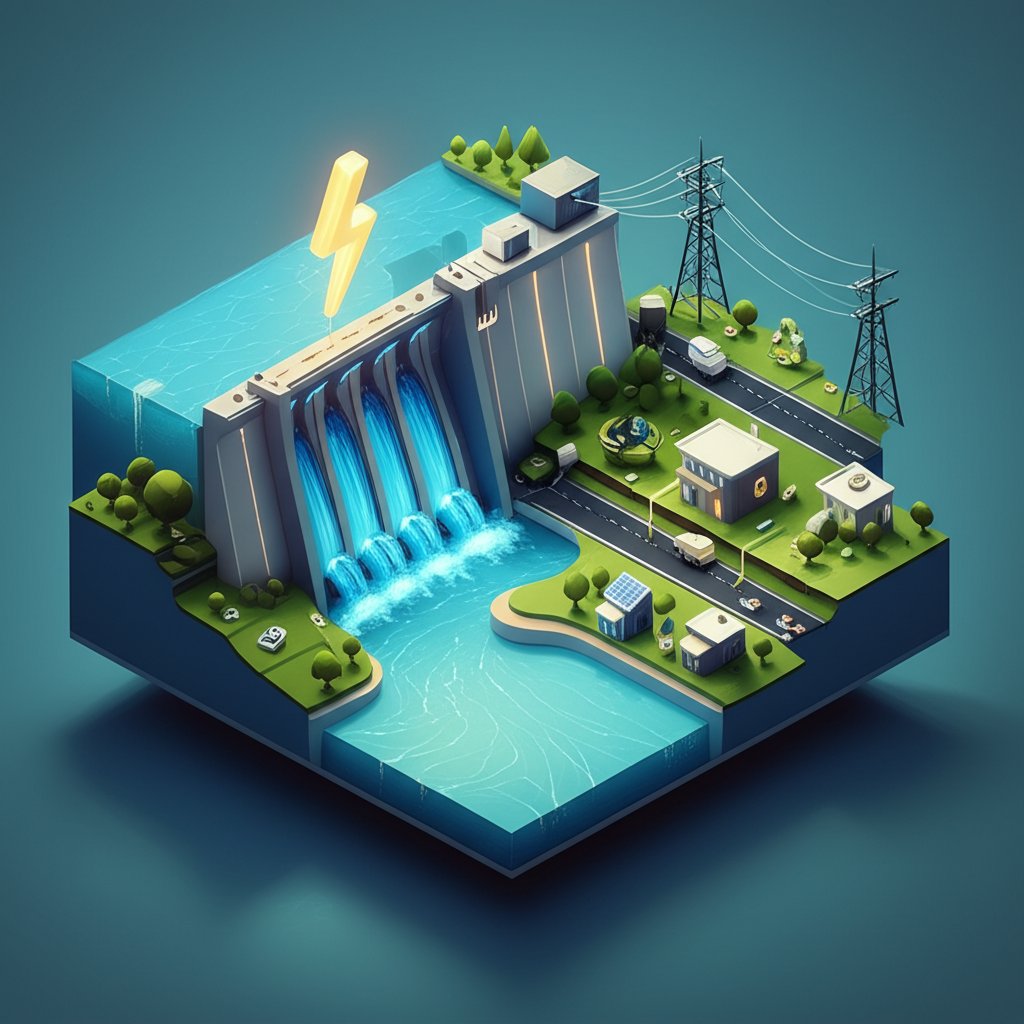
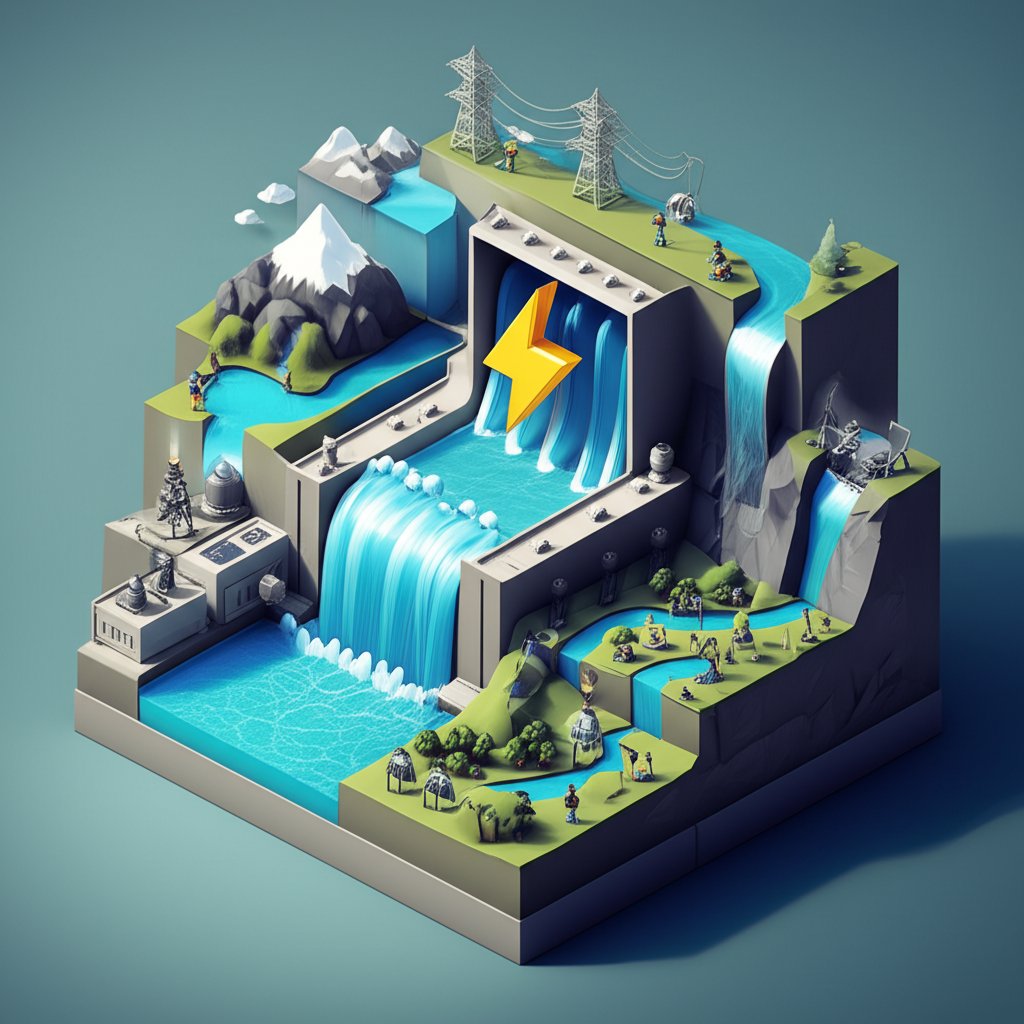
A quick glance at most hydropower pictures reveals a stunning marriage of human engineering and natural force. You see massive concrete walls taming wild rivers or serene reservoirs reflecting mountain peaks. But these images are more than just impressive visuals; they are detailed blueprints of power, telling a story of technology, geography, and the global quest for renewable energy.
Look closer at a photo of the Itaipu Dam on the Brazil-Paraguay border. You’re not just seeing concrete; you’re seeing a structure that generates enough electricity for millions. Each element in the frame—from the towering spillway gates to the subtle outline of the powerhouse—is a clue to how water is transformed into light.
See the Engineering: Learn to identify key structures like arch dams, embankment dams, spillways, and powerhouses in any photo.
A Global Photo Tour: Journey from the iconic Hoover Dam in the US to the alpine reservoirs of Austria and the powerful river systems of South America.
Read the Technology: Understand how visual cues in a picture reveal the type of hydropower technology at play, from massive storage dams to subtle run-of-the-river plants.
Spot the Human Story: Discover the people behind the power, from the engineers monitoring turbines to the construction teams who build these marvels.
Appreciate the Scale: Gain a new perspective on the immense size and complexity of global hydroelectric infrastructure.
What a Hydropower Picture Really Shows You
Viewing a hydropower facility photo is like looking under the hood of a powerful engine. At first, you see a collection of parts, but once you know what you’re looking at, you understand how they work together. The most prominent feature is usually the dam itself, a barrier built to hold back a river and create a reservoir.
This reservoir stores potential energy in the water. When released, the water flows through large pipes called penstocks to a powerhouse, where it spins massive turbines connected to generators. The generators convert this mechanical motion into electricity. Every component you see in a picture, from the water intake gates to the transmission lines leading away from the site, plays a critical role in this elegant process.
A Global Tour Through Hydropower Photography
The design of a hydroelectric facility is dictated by its location. The geology of a narrow canyon calls for a different solution than a wide, flat river valley. This is why hydropower pictures from around the world offer such a fascinating study in engineering diversity.
North American Icons: Scale and History
The United States and Canada have a long history of harnessing their vast river systems, resulting in some of the world’s most recognizable dams.
The Hoover Dam (Arizona/Nevada): Perhaps the most famous dam in the world, the Hoover Dam is a concrete arch-gravity dam. Photos emphasize its dramatic, elegant curve wedged into the Black Canyon of the Colorado River. Its sheer white face against the dark rock and blue water creates a powerful, almost artistic, composition that speaks to an era of monumental public works projects.
Keystone Dam (Oklahoma): In contrast to Hoover’s concrete arch, pictures of the Keystone Dam show a sprawling embankment dam. Made of compacted earth and rock, its long, sloping form highlights a different engineering philosophy—one that relies on immense weight and mass to hold back the Arkansas River. Photos often capture its vastness, showcasing how it reshapes the landscape.
Seebe Dam (Alberta, Canada): Not all North American hydro is massive. The Seebe Dam on the Bow River is a run-of-the-river facility. Pictures of it show a much lower-profile structure, one more integrated into the natural flow of the river, demonstrating a less disruptive approach to power generation.
South American Giants: Taming Mighty Rivers
South America is home to some of the planet’s largest rivers, and its hydropower pictures are defined by an almost unbelievable scale.
The Itaipu Dam, straddling the border of Brazil and Paraguay on the Parana River, is a titan of energy production. Photographs struggle to capture its full scope. The most compelling shots often show its spillway in action, releasing a volume of water so immense it dwarfs everything else in the frame. Images from inside its powerhouse reveal a seemingly endless line of giant generator units, each a testament to its incredible capacity. While Itaipu represents the pinnacle of scale, you can Explore hydroelectricity’s power in photos. from a wide range of global facilities to see the full spectrum of hydroelectric design.
European Engineering: Precision and Alpine Adaptation
Europe’s varied geography has led to a diverse and often highly specialized portfolio of hydroelectric plants, frequently built in challenging terrain.
Alpine Power (Austria): The Kolnbrein Dam and Mooserboden Reservoir are stunning examples of high-altitude engineering. Hydropower pictures from these sites are breathtaking, showing pristine concrete structures set against jagged, snow-capped peaks and impossibly blue reservoirs. They tell a story of harnessing meltwater in extreme environments.
French Architecture (Auvergne): The Saint Etienne Cantales dam showcases a multiple-arch buttress design. Photos capture its elegant, repeating arches, making it look as much like a Roman aqueduct as a modern power station. It’s a visual reminder that industrial infrastructure can also be beautiful.
Scandinavian Efficiency (Norway): With its deep fjords and heavy rainfall, Norway is a hydropower powerhouse. Photos of plants like the Kykkelsrud plant or smaller facilities near Lillehammer often show powerhouses built directly into mountainsides, a clever solution that minimizes environmental footprint and protects equipment from harsh winters.
Swiss Integration (Hagneck): The Hagneck power plant on the Aare river in Switzerland is a model of modern run-of-the-river design. Pictures reveal a sleek, low-slung structure that allows the river to flow through it with minimal impoundment, reflecting a strong focus on ecological harmony.
Global Diversity: Unique Solutions for Unique Environments
From the deserts of Africa to the islands of Australia, hydropower has been adapted to meet specific local needs.
Strathgordon Dam (Tasmania): Set in a remote and wild part of Australia, this is a dramatic concrete arch dam. Photos often highlight its isolation, with the thin, curved wall holding back a massive lake surrounded by untamed wilderness.
Katse Dam (Lesotho): As a key part of the Lesotho Highlands Water Project, the Katse Dam is a high-altitude marvel crucial for supplying water to South Africa. Pictures of this dam tell a story of international cooperation and water resource management in a dry region.
Kowloon Reservoir (Hong Kong): Proving that hydropower can exist even in dense urban areas, the Kowloon Reservoir in Kam Shan Country Park is surrounded by city life. Photos here create a fascinating contrast between nature, infrastructure, and the urban skyline.
Reading the Technology in the Picture
With a little practice, you can deconstruct any hydropower picture and understand the technology at its core. Look for these key visual cues.
Visual Cue
What It Is
Function & Example
A massive, curved concrete wall in a narrow canyon
Arch Dam or Arch-Gravity Dam
Uses its arch shape to transfer water pressure to the canyon walls. Example: Hoover Dam, Strathgordon Dam
A long, sloping hill made of earth and rock
Embankment Dam
Relies on its immense weight and mass to hold back water. Example: Keystone Dam
A large, circular “drain” in the reservoir surface
Bell-Mouth Spillway (Morning Glory)
A safety feature to release excess water during floods and prevent the dam from overtopping.
Large pipes running down a steep hillside
Penstocks
Carry water under high pressure from the reservoir to the powerhouse turbines. Common in pumped-storage plants.
A separate channel with large gates beside the dam
Navigation Lock
A “water elevator” that allows boats and ships to safely bypass the dam. Example: Hidrelétrica de Bara bonita
A building at the base of the dam with power lines
Powerhouse
Houses the turbines and generators that produce electricity.
The Human Element: Beyond Concrete and Steel
While the structures themselves are impressive, some of the most insightful hydropower pictures capture the human element. These images remind us that these are active, complex industrial sites managed by skilled professionals.
You might see a photo of an engineer in a hard hat, dwarfed by a giant turbine runner during a maintenance check. Other images show operators in a control room, analyzing data on arrays of screens or even using mobile applications to monitor equipment performance. These pictures connect the immense physical scale of the dam to the precision and expertise required to run it safely and efficiently.
Furthermore, photos from the construction phase are equally revealing. They might show specialized equipment, like a hydro excavator vacuum truck clearing earth for foundations, or teams of workers assembling the massive components of a generator. These images tell a story of ambition, teamwork, and the incredible effort required to bring a new hydroelectric power plant online.
Quick Answers to Common Questions
Q: Are all hydropower pictures of giant dams?
No, not at all. Many photos show “run-of-the-river” facilities, like the Hagneck plant in Switzerland, which have small dams or no reservoir at all. They use the natural flow of the river to generate power. Other images capture different technologies, such as underwater turbines used for generating tidal power, which is another form of hydroelectricity. Q: What is the most visually dramatic feature in a dam photo?
The spillway in operation is often the most spectacular sight. A photo of a dam releasing massive, controlled torrents of water is a powerful demonstration of the forces at play. The spillways at the Itaipu Dam, when fully open, create a visual that is both awesome and intimidating. Q: Do hydropower pictures only show the positive side?
Most promotional or technical photos focus on the engineering marvel and clean energy production. However, they are part of a much larger and more complex story. A complete understanding of hydropower also involves considering the environmental impact of damming a river and the social consequences of creating reservoirs, topics that aren’t always visible in a single, flattering image. Q: Can you tell if a power plant is “green” just from a picture?
A picture confirms that the facility is a source of renewable energy, as it doesn’t burn fossil fuels. In this sense, hydropower is a key form of green energy, often presented alongside solar and wind. However, the term “green” is complex. The full environmental impact, including effects on fish migration and local ecosystems, is a subject of ongoing study and isn’t something that can be fully assessed from a photograph alone.
Hydropower pictures are far more than just scenic shots of industrial sites. They are windows into a world of incredible engineering, global diversity, and the constant human effort to harness the power of water. The next time you see a photo of a dam, look past the initial spectacle. Try to identify its type, locate the powerhouse, and imagine the immense turbines spinning deep inside. You’ll find a deeper appreciation for these structures that quietly and powerfully light up our world.
I am a writer who loves renewable energy, with a focus on sustainable living, renewable energy, and eco-friendly innovation. With a passion for environmental awareness and a desire to explore the latest trends in green technology, corporate sustainability, and climate action. Through in-depth storytelling